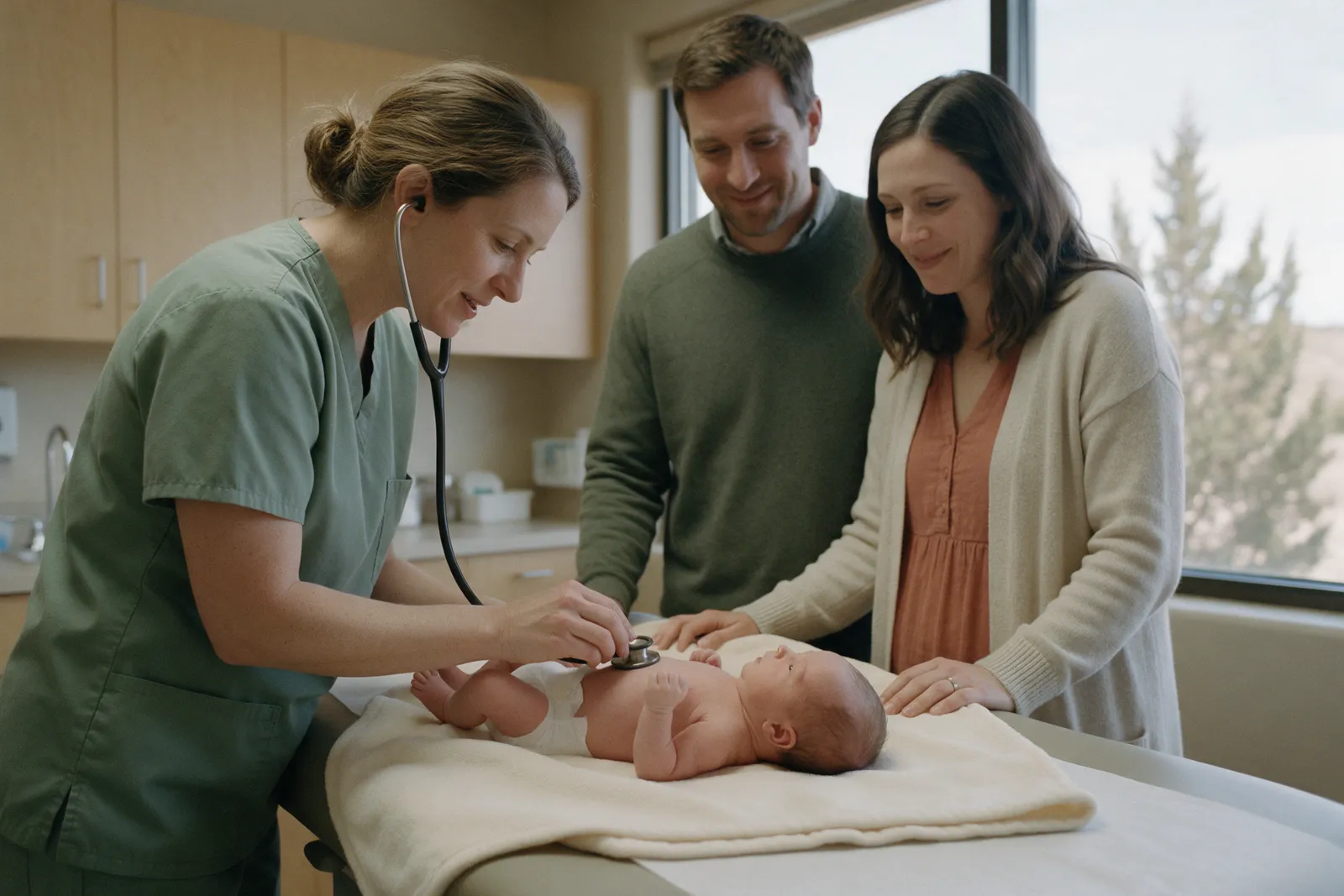
Your baby’s first office visit should happen at 3 to 5 days old, or within two to three days of leaving the hospital. That is the timing the American Academy of Pediatrics recommends, because it is when feeding problems and jaundice most often show up. The visit is short and practical. You do not need to have anything figured out before you come.
Book it before you leave the hospital
Call us from your hospital room at (541) 555-0148. We keep newborn appointments open every weekday for exactly this. If your baby is born at St. Charles Bend, one of our providers may already have seen them in the nursery on morning rounds, and we will have the hospital notes before you arrive.
Not yet a patient? Newborns are welcome. Our new patient page explains how joining works, and it takes one phone call.
What we check
- Weight. Most babies lose some weight in the first days, up to about 7 to 10 percent of their birth weight, and are back to it by around two weeks. We compare today’s weight with birth and discharge.
- Jaundice. A yellow tinge to the skin and eyes is common in the first week. We look at how far it has spread and may check the level with a skin meter or a small blood test.
- Feeding. How often, how long, and how it is going for you both. Most newborns feed 8 to 12 times in 24 hours.
- Diapers. By day 5 or so, expect at least six wet diapers a day and yellow, seedy stools.
- A full exam: heart, lungs, hips, eyes, skin, reflexes and the umbilical cord stump.
- Hospital results: the hearing screen, the first newborn blood screen and the hepatitis B vaccine.
Oregon screens every baby twice. The second blood spot is collected at 10 to 14 days old, usually at the two-week checkup, and it looks for conditions that do not show up in the first days of life.
What we will talk about
- Safe sleep: on the back, on a firm, flat surface of their own, with nothing else in the crib. Sharing your room, but not your bed, is safest for the first six months.
- Vitamin D: babies who are breastfed, fully or partly, need 400 IU a day as drops.
- The fever rule: a rectal temperature of 100.4°F or higher means a call to us, day or night.
- Car seats: rear-facing, in the back seat, harness snug at the shoulders.
- How you are doing. We ask the birthing parent a few questions about mood and sleep at the early visits. Postpartum depression is common and treatable, and your baby’s checkup is a good place to catch it.
What to bring
- The hospital discharge papers, with birth weight, discharge weight, the jaundice level and the hearing screen result
- Your insurance card. Many plans need a newborn added within 30 days of birth, so call your insurer this week
- A rough feeding and diaper log. Notes on your phone are fine
- Your questions, written down. Nobody remembers them in the room
- Diapers, wipes, a spare outfit and a blanket
- A second adult, if you can. It helps to have someone else hold the car seat and listen
Feeding help, if you need it
Tessa Lindqvist, our nurse practitioner and board-certified lactation consultant, runs a newborn feeding clinic on Tuesday and Thursday mornings. Latch trouble, low supply, a baby who is slow to regain weight, or questions about formula: bring any of it. You can read more about Tessa or ask for her when you book.
Do not wait for the appointment if
Call us now, at any hour
- Your baby has a rectal temperature of 100.4°F or higher, or below 97.5°F
- They are too sleepy to feed, or are feeding far less than before
- They have fewer wet diapers than expected, or dark, strong-smelling pee
- The yellow color is spreading to the belly or legs, or getting deeper
- They vomit green fluid
Call 911 if your baby is struggling to breathe, turns blue or gray, or will not wake.
After this first visit, the next checkups come at one month and two months. Our guide to the well-child visit schedule shows what each one covers.
Sources
- American Academy of Pediatrics: Bright Futures recommendations for preventive pediatric health care
- American Academy of Pediatrics, HealthyChildren.org: A parent’s guide to safe sleep
- American Academy of Pediatrics, HealthyChildren.org: Jaundice in newborns
- Oregon Health Authority: Northwest Regional Newborn Screening Program